|
Medical Student Corner
Abdominal Pain
A.R. is a 40-year-old woman who presents to your
office with the chief complaint of worsening
abdominal pain for three days.
She also complains of nausea,
vomiting, and constipation, and has not had a bowel movement in almost
a week. She denies fevers, chest pain, or shortness of breath.
She has no significant
past medical or surgical history, takes no medications, and
has no allergies. She does, however, smoke five cigarettes a day, and
drinks alcohol socially.
She works for a sign and
placard company.
On examination, she is
in mild distress due to abdominal discomfort. Vitals are significant for
a pulse of 110 and blood pressure of 150/70. Lungs are clear, and heart
exam is normal. Abdominal exam is significant for hypoactive bowel sounds
and moderate diffuse tenderness, without rebound or guarding.
You also hear egophony
- "E to A" changes on auscultation - in the abdomen.
Labs are completely normal.
You're stumped until a
colleague suggests you get an abdominal x-ray, which shows the following:
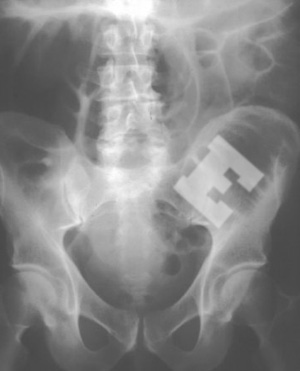
What's going on?
Answer:
Large Vowel Obstruction
This patient, a 39 year old woman who works for a
sign and placard company, has a large vowel obstruction.
The presence of a large vowel in the colon on plain
film of the abdomen is pathognomic for this disorder, and clinches the
diagnosis.
Large vowel obstruction is difficult to diagnose
on physical exam alone, but the presence of "E to A" changes
during auscultation of the abdomen is highly suggestive, and should prompt
experienced clinicians to order abdominal films at their earliest convenience.
On further questioning, it was discovered that the
patient had recently been involved in an untoward incident at work involving
a "FOR SAL" sign.
A colonoscopy was performed, and the offending vowel
was removed without complications. Vowel rest was advised, and the patient
recovered fully.
|